

The opinions expressed in the following article are solely those of the writer. The opinions expressed are not those of Tony Stiles or TonyStiles.com
Drones, Drones, Everywhere...
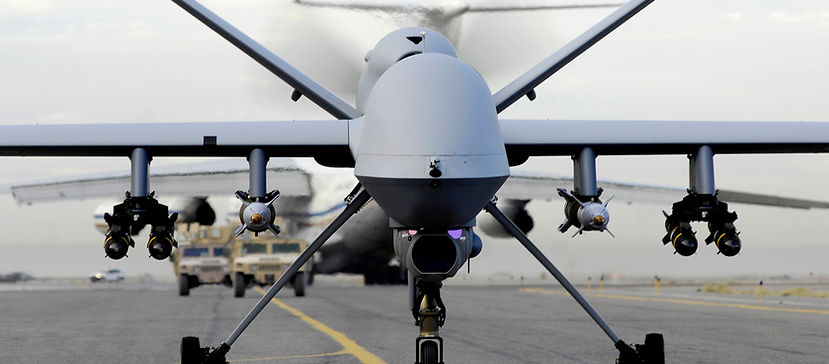
To one witnessing the recent uproar over the allegedly nefarious usage of unmanned aerial vehicles (UAV’s), aka drones, it seems as though misguided hysteria is the flavor of the month. No, this is not an article commenting on Obama’s profligate use of remote-controlled murder machines, nor on the approval of such use by the self-proclaimed, “not libertarian”, Rand Paul. Rather, the tumultuous storm of bad press of which we speak has been over the supposed potential for sexual prowess now possessed by private drone owners in the form of their GoPro equipped UAV’s.
This latest installment in the endless saga of people abandoning common sense to justify attacking property rights was brought to light on June 8th when a Connecticut man posted a cell phone video he took of himself being viciously attacked by a crazed woman. Why? Well, because he was obviously sexually harassing all of the female sun bathers by flying his UAV high above the beach they were on, of course. Evidently, sexual harassment is expanding the parameters of its definition nowadays.
I would say that the ensuing headlines have been astonishing, however the attacks on Miss Nevada over self-defense and the acceptance of the bait in 4chan’s #EndFathersDay prank by some radical feminists has shown that nothing is surprising anymore. That doesn’t make it any less head-scratching to read such gems as Sexual Harassment by Drones a Growing Concern, Sexual Harassment by Drone is Now a Thing, and Are Flying Drones a Peeping Tom’s Dream Tool, though.
One doesn’t actually need to read the accompanying articles to know exactly what message is being conveyed: something needs to be done about the “anonymous creeps” who are operating these UAV’s while they “hide at a safe distance and snap away via remote control.”
For extra ammunition, in addition to the Connecticut story the articles also include details regarding an alleged incident posted on Reddit last month involving a woman and her mother confronting two drone operators for “violating every woman on [the] beach.” Something obviously must be done, right?
Wrong.
For starters, even if these supposed pervs are secretly snapping photographs of women on beaches, barring local laws to the contrary, there is nothing that can be done. From an attorney specializing in IP and environmental law:
“Members of the public have a very limited scope of privacy rights when they are in public places. Basically, anyone can be photographed without their consent except when they have secluded themselves in places where they have a reasonable expectation of privacy such as dressing rooms, restrooms, medical facilities, and inside their homes.”
The Supreme Court has more specifically ruled, albeit in police/government search cases – which seemingly would require greater safeguards for privacy – that aerial photography while in publicly navigable air space (even while over private property!) is not a violation of privacy.
So while people taking potentially unwanted photos may indeed be “creeps,” they are not doing anything wrong. In fact there are already existing laws protecting unlawful photography, including the Video Voyeurism Prevention Act of 2004, and we truly don’t need any more additions to the Federal Register.
If the idea of the legitimacy of public photography is still somehow repulsive to the senses, then perhaps the technological reality of the capabilities of the GoPro and other like digital video recorders will put the mind at ease.
Remember that nugget of extra ammo from Reddit mentioned above? What all the “journalists” who used that ammo have failed to update their audience about (except the SF GATE ) is that the original poster of the complaint has since removed her post after being thoroughly rebuked by a tech savvy contributor to that site. I would recommend reading the entire post, however to satisfy the above point of clarifying the technological reality of capabilities, Quadzimodo, explains:
Most cameras fitted to small hobby grade unmanned aerial vehicles like the one you describe are used for an activity commonly known as FPV (which stands for First Person View). …
Unfortunately, the reality of achieving a rewarding FPV experience means dealing with a range of technical challenges, perfecting hardware and system configuration, then in the end settling for image quality with just enough definition and resolution to judge depth of field, distance from obstacles and objects and clearly identify orientation. In short, an FPV link is hardly a useful tool for someone intent on invading the privacy of others. …
Strapping a GoPro or simular [sic] to a small unmanned aerial vehicle might seem to the uninitiated like a good way of capturing intimate footage of unsuspecting civilians. In reality however this simply isn't the case. Things like natural beauty, built heritage and scenery are a particular specialty when captured from a distance. If you are to view anatomy through a GoPro though, you do need to get right up close. This is not a question of interpretation, it is a question of focal length and basic physics.
To explain... Be it a blessing or a curse, virtually all small video cameras employed by hobby droners (including the latest and greatest incarnation of the almighty GoPro) feature a wide angle lens in the order of 120-degrees (particularly wide angle). Nor do they have any zoom potential to speak of. You can see that this is not going to overly effective at stealing someone's innocence from afar.
Flying a drone close enough to beachgoers to invade their privacy would be stepping well outside the guidelines for proper use, would create an outright nuisance due simply to it's [sic] proximity to people and probably be throwing up sand all over the place. Even when recording in full 1080P HD format with the field of view native to these small digital cameras and a digital canvas of 1920x1080 pixels, a subject the size of a human is occupying a miniscule area within the frame at the distances concerned. Certainly not worth the effort for a bit of voyeurism I don't think. In fact, the reddit logo above probably has more pixels for the imagination to work with than any footage this father and son might have of you.
There is, however, one facet of each of the articles, and one separate article in particular, that would be of legitimate concern if the reporting on details regarding the incident was accurate.
The piece at issue is regarding an incident from May of 2013 where an UAV operator flew his drone up right next to the third story window of a home in Seattle, and when confronted by the homeowner, he allegedly “insisted that it was legal for him to fly an aerial drone over our yard and adjacent to our windows.”
According to The Atlantic, who published the article specifically on this incident, the operator was correct in his assertion. Writes the author, “[w]alk onto someone's lawn and you're trespassing; fly over it in a helicopter and you're in the clear -- "the air is a public highway," the Supreme Court declared in 1946.” Well, kinda-sorta, but not really.
In United States v Causby, SCOTUS did indeed affirm Congress’ assertion from the Air Commerce Act of 1926, as amended by the Civil Aeronautics Act of 1938, that “[t]he air above the minimum safe altitude of flight prescribed by the Civil Aeronautics Authority is a public highway and part of the public domain. … Yet it is obvious that if the landowner is to have full enjoyment of the land, he must have exclusive control of the immediate reaches of the enveloping atmosphere.”
Apparently , the author at The Atlantic did not fully read through the majority opinion of the case, as SCOTUS clearly – and rightfully – defined the air space immediately surrounding one’s property as owned and controlled by the landowner. Furthermore, in Katz v United States, SCOTUS introduced the groundwork for the reasonable expectation of privacy by laying down the two-part test, “first that a person have exhibited an actual (subjective) expectation of privacy and, second, that the expectation be one that society is prepared to recognize as "reasonable." The sanctity of one’s home most certainly passes both criteria of the test.
In conclusion, this recent hullabaloo has been much ado about nothing. If you do not want to be photographed/recorded in a bikini, don’t go out in a bikini. A person exercising their right to photograph in public spaces, even when done from above when women with high self-esteem are present, does not constitute sexual harassment. And don’t worry anyway, to paraphrase Quadzimodo, anyone with a good camcorder or cell phone produced within the last 5 years can get far better pictures of you than any UAV enthusiast with the latest GoPro attached.
For those clamoring for government intervention into this nonsense, I caution, be careful what you wish for.
- Chris Lewis 06/20/14 08:00 AM CT
