


The opinions expressed in the following article are solely those of the writer. The opinions expressed are not those of Tony Stiles or TonyStiles.com
Drug Prohibition: What Are Those Policymakers Smoking?
As a country, we have a huge problem of treating public policy as some educational curriculum intended to represent what we accept culturally, and as a consequence letting politicians off the hook for disastrous legislation because they supposedly meant well. There is no more vivid example of this than the topic of this week’s show - our drug policy, and sadly anti-prohibitionists are often as guilty of these trends as prohibitionists. My personal belief is that every adult has the right to do whatever we want with our own bodies, but that belief is ideological and as a political scientist and structural anarchist I march to the beat of a very different drum. So today, instead of talking about personal choice, I’m going to introduce a completely different approach that I encourage readers to use anytime they encounter apologists for prohibition – I promise you they won’t stand a chance.
In political science, there is really only one reasonable criterion for evaluating laws and that is a rational cost/benefit analysis of their outcomes. It follows that politicians who pervasively advocate for policies proven to do more harm than good should be fired; not out of vindictiveness but simply because they are adults failing at their jobs. In some domains there is room for debate regarding costs and benefits, but the evidence against drug prohibition is so overwhelming that keeping it on the books only demonstrates our infantile approach to the issue. To show readers that you do not have to be a political scientist to effectively argue this, let’s conduct that cost/benefit analysis ourselves.
Firstly, Does Prohibition Work?
In answering this question, it’s important to acknowledge that vice prohibition DOES reduce demand. As a teenager, I had the impression and often made the argument that drug laws should be abolished because they don’t stop anyone; but all the research I have seen indicates they in fact do significantly reduce consumption. Overall alcohol consumption in the US was the lowest in our history during prohibition in the 1920s, and all the data indicates that when States legalize cannabis, even only for medicinal use, they experience significant jumps in consumption as well. Hence, if you encounter a somewhat educated prohibition advocate and claim that drug laws don’t accomplish anything, they may produce that research to back their support for educational programs like DARE and tough punitive measures against users – which are aimed at demand reduction. A far better counter-argument is that the rationale for drug laws is not to reduce consumption but to reduce the negative outcomes associated with it. Make the argument that there is no need for demand reduction because adult drug use is perfectly acceptable and many Americans will, with varying degrees of emotionality, veer off into horrifying allusions to health problems, addiction, reduced productivity, petty crime in pursuit of more drugs, negligent behavior such as driving under the influence, and so forth.
But there is zero evidence any of those outcomes actually correlate with drug use despite billions in government grants spent on research to find them, and that constitutes the gaping hole in prohibition’s argument. The meth junkie I almost ran over last week because she was walking down the middle of the freeway at 3AM – she is not representative of users. Neither is your loser unemployed cousin who is 32-years-old and sits in your uncle’s garage smoking cannabis and playing video games. These are just the cases public policy and mainstream media choose to focus on in hopes you will make that association, complete with graphic photographs to appeal to emotion and discourage rational questioning. Nor does sensationalized misuse of statistics such as replacing actual risk calculations with likelihood comparisons qualify as evidence. Let’s say (making up random numbers for illustration) a DEA-sponsored ad reports an adolescent that uses marijuana is 10 times more likely to die of a hard drug overdose than one who does not. It sounds scary until we look up the statistics being compared and learn the odds of any adolescent dying of a hard drug overdose are 1 in 10 million, whereas for an adolescent that uses marijuana they are 1 in 1 million. The 10 times comparison is accurate, but if you’re any sort of intelligent the thought of your pot smoking 17-y-o overdosing on methamphetamine at a party should no longer keep you up at night.
In order to convince ME that drug use is indeed associated with the outcomes listed above and hence reducing demand puts a dent in them, prohibitionists need numbers indicating that a significant proportion of drug users end up with the associated outcomes AND far more importantly, that people who use drugs and end up with those outcomes wouldn’t end up with them anyway. And I know they don’t have those numbers because I have conducted the research myself in graduate school despite the passive aggressive disapproval of my professors. I put together a simple study on existing Department of Health data sets, and found that separating drug abuse as it is defined by clinical psychologists from recreational use demonstrates that abuse correlates with every risk (car crashes, STDs, violent crime, suicide, etc.) but recreational use correlates with none of them, even in teenagers. Further, my study found that both those risks and drug abuse correlate with poverty – indicating that teenagers living on handouts in trash neighborhoods with dysfunctional families are kind of screwed whether they abuse drugs or not. But fear not, there is more to fall back on than just the work of a disgruntled Master’s student, such as the research of Tony Stiles’ guest this week, Dr. Carl Hart – a Columbia University neuroscientist who sits on multiple national boards dealing with issues of drugs and mental health. In an interview with the Huffington Post’s Matt Sledge, Dr. Hart puts it plainly. “The vast majority of drug users never become addicted. When you really look at the data, you see that most people who use drugs don't have a problem with them. Some even become president: Barack Obama, George Bush, Bill Clinton -- all of these folks have used.”
So if empirical science clearly cannot demonstrate the relationship between drug use and negative outcomes, why do we as a society continue to throw more resources toward a policy aimed at preventing the former? Why do the politicians who endorse this waste still have their jobs? Why were my professors – educated and well-meaning people who understand science – trying to discourage my own research with implications that I’m encouraging adolescent drug use? It would seem to me this is because public education programs and other government-sponsored propaganda drill the associations into us so effectively that by adulthood they seem as obvious as gravity, with even many drug users viewing their own behavior as deviant and living in terror their children will take it up. Our culture has been manipulated for decades not to think of this issue in scientific terms, and the roots lead us to the other, equally important question.
Secondly, what does prohibition cost?
This question is not unnecessary despite the lack of evidence for prohibition having any real benefits because a sizeable minority of Americans believe that drug use is immoral for a variety of ideological reasons, and will maintain that reducing demand by itself is a good thing. Most such Americans are relatively conservative, however, and demonstrating that the costs of prohibition are black market induced violence and an ever-more intrusive, insultingly expensive police state is a good way to help them rethink their position.
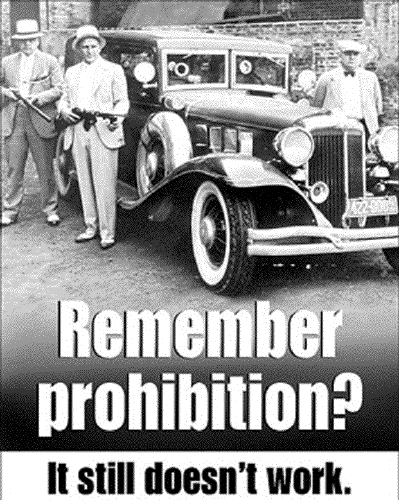
Prohibition reduces demand but does not eliminate it, anywhere, ever. There was drug use in the USSR with its state run industry and agriculture and very tightly closed. There is drug use in countries like Singapore and Cambodia where it is punishable by extreme sentences including death. And of course, there was plenty of alcohol consumption in the US during the 1920s. To quote Chris Rock, “these laws don’t work because people want to get high”, and hence prohibition creates black markets by eliminating legal supply where there is clear demand.
THIS is prohibition’s most devastating cost although it’s rarely talked about. Black markets mean violent turf wars between organized crime cartels as a form of competition – a death sentence for 100s of poor Americans yearly living in the neighborhoods where they take place, many of them simply caught in the crossfire or adolescents used as fodder by high level criminals. Black markets mean products peddled by criminals who are not answerable to any kind of industry standards set by market or regulation – leading to unpunished harm caused by bad product as well as violent crimes against customers that refuse to pay or otherwise quarrel with dealers. Black markets mean the enrichment and empowerment of criminals as they now have something to sell at an inflated price, allowing sociopaths that would otherwise get locked up for hold-ups to turn into kingpins with money and power. In extreme cases, this effect can threaten the rule of law in entire countries, as is currently happening in Mexico whose drug cartels are funded entirely by drug prohibition in the US. And finally, black markets mean immeasurable amounts of resources poured into futile law enforcement attempts that only create more work for themselves – a separate cost I will address shortly.
Long-dead neoconservative talk show host Morton Downey Jr. frequently claimed that the number of alcoholics in the US increased tenfold when alcohol prohibition was repealed, and proceeded to ask if that was worth it. My answer is a resounding yes even if I accept his ridiculously exaggerated numbers – because even an exponential increase in drug addiction in the US would be well worth the lives and resources saved through the accompanying reduction in organized crime. But in this case too, there is more evidence to fall back on than just my pointing out the other side of the equation. Another of our guests this week – long time medical marijuana grower and patient Mike Boutin who has experienced firsthand the legal transformation of cannabis, made one of the most important statements I have ever seen about growers and dispensaries in a recent interview with High Times. “I think” he said about a recent documentary with his participation, “we tried to show people what it takes to get through a growing season and mostly, there is nothing sensational about it. It’s hard work and risk from all sides.” The allure of black markets is the prospect of easy money hedged by high occupational risk; and allowing competition from hard-working businessmen that have passion and accountability for the quality of their product is the way to force professional criminals to go back to hauling bricks like they’re qualified to do. Imagine what would happen to the Zetas cartel if tomorrow, we allowed professional chemists to compete with their semi-enslaved methamphetamine cooks in Southern Mexico, and legitimate tax-paying businesses to harvest and import opiates and cocaine. Is the prospect of more people using, most of them responsibly and in moderation, really scarier than a brutal criminal organization sending messages by displaying rows of decapitated heads?
That question brings us to the other major cost of prohibition, the cost of enforcement. Thanks to activists like our third guest, Danny Panzella of the non-partisan Peaceful Streets Project, law enforcement excesses and strategies to holding law enforcement accountable have gotten much needed public attention in recent years. But where did these excesses emerge from, and what is their connection to prohibition? Well, while some of the laws have been on the books nearly a century, serious enforcement began under Richard Nixon and expanded under Ronald Reagan with the initiative called the War on Drugs, which consisted of minimum sentence legislation, the funding of specific law enforcement agencies and border militarization, and the sponsorship of volumes of pseudo-science and propaganda that have successfully driven our culture to treat drug use as fear-inspiring deviance without a morsel of evidence in support. The result was a dangerous circle-jerk between these policies and the special interests they coined.
Minimum sentences and a focus on drug enforcement drove the US to become the incarceration capital of the world – with anywhere between 25% and 50% of our inmates in 2010 doing time for non-violent drug related crimes according to the Justice Policy Institute. The costs of this amount to more than just the direct price of imprisonment. They amount to 100,000s of capable people removed from the labor force and often turned into slave labor by corporate inmate employment contracts. They amount to large numbers of inmates initially incarcerated for petty crimes learning how to become major criminals, especially when the conviction follows past incarceration and makes it difficult for them to get jobs or formal education. But costliest of all, prison crowding feeds the correctional interests who in turn promote policies to perpetuate it.
That initial growth of prisons coupled with the “whatever it costs to convince Americans and for these agencies to succeed” attitude created a large number of well-paid, unionized jobs in correctional and Federal enforcement industries – constituting a class of people with little education, a lust for power, and a vested interest in growing the prison population and funneling money toward propaganda and failing enforcement initiatives. Their overgrown political influence and campaign contributions in turn played a large part in transforming the Republican Party from limited government to advocating the erosion of Constitutional protections and expansion of policies to fight imaginary threats like drugs and terrorism, while simultaneously securing and increasing the jobs of correctional workers, Border Patrol, and the DEA. In more recent times, corporations who employ prison labor as well as those that build and supply the militarization equipment have also joined in the lobbying, creating a wider and more dangerous coalition. In the wake of 9/11, the power wielded by these special interests brought us the Patriot Act and the Department of Homeland Security, so it is to their lobbying that we owe the joy of being molested at airports, spied on in our private conversations, and seeing mine-resistant personnel carriers in our streets. While drug prohibition is not solely responsible for these trends, it constitutes a sizeable chunk of the price tag of our militarized law enforcement for which we have no return whatsoever. It also contributes greatly to the erosion of civil liberties and Constitutional protections from government.
All three of our guests have commented on the high-jacking of the prohibition debate by this special interest. “There’s always the possibility of trouble,” Mike Boutin said in the same interview, “but mostly from the cops in the air or in convoys. There is constant surveillance; I have seen military drones, in-flight fueling of military surveillance aircraft, and more. There is a concerted effort to “jacket” anyone involved in the trade.” The use of the same equipment and tactics against peaceful growers that is used against Al Qaeda in Pakistan or Yemen is quite disturbing, and let’s remember the funding for that technology was obtained by the lobbying of agencies predecessors whose primary mission was drug enforcement. Dr. Hart puts it even simpler. “[T]o ask the cop [about prohibition] is stupid in my view.” He says. “Cops are paid to go after a criminal, that’s it, and we have defined these guys as criminals.” As I’ve mentioned before, the work of Danny Panzella and the Peaceful Streets Project has been quite promising in raising awareness about law enforcement excesses and curbing this special interest’s political power by exposing it and bringing it to accountability, but removing the illusion of its members being expert voices on drug policy is also a necessary step in that battle.
Conclusion
The cautious conclusion is that drug prohibition does more harm than good and should be repealed. This is not the equivalent of advocacy for drug use or abuse, but merely an acknowledgement that we need more science-based policy because the current one is not working. Most drug use is not problematic, and in the cases where it is – it ought to be treated as a health problem. Like many health problems, it involves an element of choice just as poor diet and lack of exercise lead to cardiovascular disease and voluntary exposure to carcinogens lead to cancer. Also like most health problems, it depends heavily on environmental factors. The rationale for placing drug abuse on a criminal pedestal simply does not exist, other than that it creates actual criminals and hence jobs for law enforcement to fight them. The War on Drugs started as a neocon band-aid on the hemorrhage of the welfare state, and it has failed completely to stop the bleeding, but taken on a life of its own. Anyone advocating for it is likely falling back on propaganda originating from lobbies associated with industries profiting from it, because there is little else supplying evidence in its favor.
By: Neurotoxin
About the Editor:
Neurotoxin holds a dual BA in Psychology and Political Science and an MSW with a specialization in Community Organizing. Politically, he is a “structural anarchist”; a school of thought that believes in treating all power structures as facts of nature that should be accounted for but not preserved. This school of thought dictates that policy ought to be driven solely by its empirically calculated outcomes.
Neurotoxin is the co-owner of Edge of Chaos – a political podcast and blog that can be found @ www.edgeofchaospodcast.com and http://www.facebook.com/theedgeofchaos.
